On this page
RoboDot Touch Screen UI
Read status, survey points, control a base, and use stakeout directly on RoboDot without connecting a phone.
Home Screen
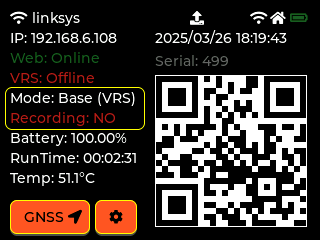
The Home screen shows the device’s IP address and status. Scan its QR code from a phone on the same network to open the web UI.
Screen Launcher
Tap the Home screen's background to open the launcher — a grid of one-tap buttons for Survey, Base, Stakeout, Files, Settings, and Home. The header shows the installed firmware version, the first thing to check when comparing units or contacting support.
GNSS Screen
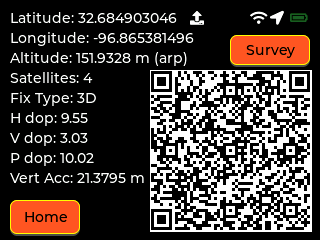
The GNSS screen shows position and fix quality. Use its QR code to copy or share the position.
Survey Screen
The Survey screen shows the live position and fix quality, and — when the device is a rover — a Shoot button that records a point at the current fix straight into the active job's shot file. Marking points no longer requires a phone or browser. If the device is not in rover mode, the screen explains why and offers Make Rover in place.
Base Screen
The Base screen carries the live position plus the Survey / Release control for setting and releasing the base position — the same operation as the web UI's Status page, available at the pole.
Stakeout Screen
A needle dial that points at your chosen target and counts down the distance, with a bullseye inside 0.25 m. Targets come from job shot files and Favorites. See Stakeout.
Files Screen
Answers "what is this unit writing right now?" at a glance: the active shot (.sht) and observation (.rub) file names update live, alongside per-job point and file counts and the SD card's free space.
Settings Screen
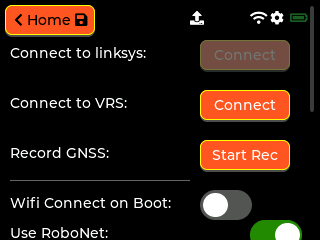
Use Settings to change the device’s boot options and connections.
Press Home to save changes to toggles and dropdowns. Most changes take effect after a restart.
Don't forget to save any changes to the toggles by clicking Home.
Icons
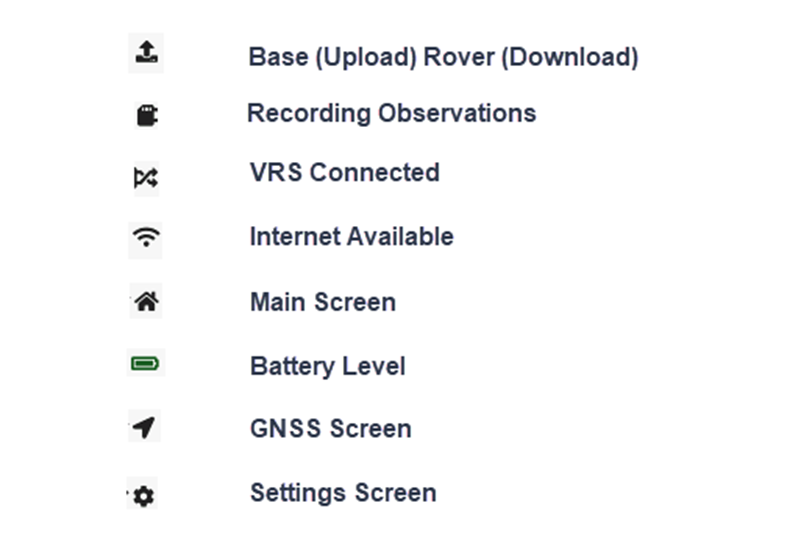
Icons along the top of the touch screen serve as a quick status reference.